
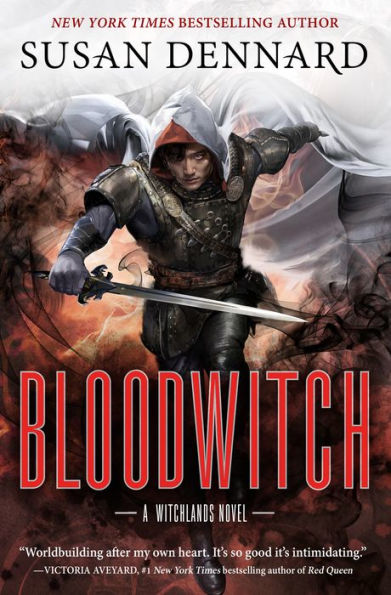
The Blurb
High in a snowy mountain range, a monastery that holds more than just faith clings to the side of a cliff. Below, thwarted by a lake, a bloodthirsty horde of raiders await the coming of winter and the frozen path to destroy the sanctuary and its secrets.
The Bloodwitch Aeduan has teamed up with the Threadwitch Iseult and the magical girl Owl to stop the destruction. But to do so, he must confront his own father, and his past.
Review
*Spoiler warning!*
Read: February 2019
Rating: 5 stars out of 5!
As I mentioned in a previous review, I’ve discovered some amazingly good books (and their attached series) through the “Books Under $2.99” section of the NOOK Store. That’s how I tumbled into the Witchlands series: My poor spending habits and I spotted Truthwitch, looked at each other, and said, “Eh, why the fuck not?” I will admit that I had my trepidations about Truthwitch as I was reading it, but I saw a lot of potential in it and forged on. By the end of the first book, I was completely hooked on the Witchlands series and read the next book, Windwitch, about a month later. It turned out to be even better. And OH MY GOODNESS, BLOODWITCH WAS GOING TO FOCUS ON AEDUAN?!?!? Try as I might to convince myself that I shouldn’t, I preordered it around the holiday season. The day it released, I was glued to my NOOK.
Susan Dennard’s debut series features an intricate system of magic, and with complicated magic systems, there exist greater opportunities for bungling both details and delivery. Witchlands avoids these mistakes: Dennard eschews info-dumping, instead opting to provide information as things crop up. Bloodwitch builds well upon the material of the first two books. In this installment of the series, readers get an even closer look at the mechanics of both regular magic and (*shudder*) Cleaving, and – in what I pictured as a super-intense Monsters, Inc. sequence – our heroes utilize a set of magic doorways between numerous locations (many of which are apparently very near to the Origin Wells). Those of you who are history/geography buffs won’t be disappointed either, since Bloodwitch‘s setting explores even more of the Witchlands. Although Safi and Vaness have actually made it to Azmir, Aeduan and Iseult – along with their headstrong charge, Owl, and her monstrous mountain bat, Blueberry – are still en route to the Carawen Monastery in the Sirmayan Mountains, and Merik has been whisked away to Ponzin. The variation in setting throughout the story will satisfy your inner adventurer and fend off setting fatigue. And the complex plot will make you anything but bored: There’s plenty of action and big reveals to keep you entertained.
The character development in Bloodwitch is top-notch. I’m gonna be honest: I didn’t like Safi’s character all that much at the beginning of the series. But she really has grown on me as she herself has grown, and now I love her. While she may not be clever in the way that Iseult is, she has proven to be smart in her own right. When Vaness’s birthday celebration devolves into a complete and dangerous fiasco, Safi’s leadership skills step to the fore as she reasserts her autonomy and helps Vaness escape. In Lovats, Vivia is stepping into a new leadership role as Queen-in-Waiting, but her opponents – including her own manipulative father, King Serafin – have no qualms about stomping on her toes to curb her ascent. Vivia eventually realizes that she doesn’t need her father and that she needs to make her own decisions rather than constantly submitting to him. Meanwhile, Iseult continues to take initiative and have confidence in her snap judgments. Owl too evolves from being an overpowered mega-brat (get it? It’s a pun on “mega-bat”… Never mind) with a contrarian attitude problem. Slowly but surely, she emerges from her shell to befriend Iseult and proves herself unfalteringly loyal to her friends, even if she is still obstinate.
Obviously, though, this book focuses most on Aeduan’s internal journey, and his redemption arc is a powerful one. For more than a decade, Aeduan has been plagued with guilt and self-loathing. In Bloodwitch, readers gain an in-depth comprehension of why. The long and short of it is that Aeduan’s childhood traumas caused him to brand himself as a monster, and this view of himself allowed him to justify his unquestioning loyalty to his father, even when Ragnor’s orders were patently immoral. By the end of Bloodwitch, Aeduan has learned to forgive himself and that there is a path towards salvation for him.
And finally, the romance. God, the romance. Throughout Bloodwitch, Dennard continues to build upon the romantic tension between Aeduan and Iseult, culminating in the implication that they are Heart-Threads. At the end of the book, Aeduan has been separated from Iseult but vows to find her, and all I can say is that I am so ready for that journey back to each other. Just let my OTP be together. (Side note: Does anyone else spy a blossoming romance between Vaness and Vivia?)
Here I am at the end of this review and there are so many things that I haven’t touched on, simply because I can’t do them justice. Bloodwitch has more than earned its place on my Favorites and Cream-of-the-Crop shelves, and I enthusiastically recommend the Witchlands series to any fantasy fanatic. I’m on the edge of my seat waiting for Book Four!

 The Book Hawk